
7 Ways to Immediately Improve Your Spoken Japanese (Absolute Beginners too)


The only way to get better at anything is to do the thing.
Want to get better at tennis? Play lots of tennis.
Want to get better at cooking? Cook a ton.
Want to get better at speaking Japanese? For the love of God, speak Japanese!
Sounds simple but so many language learners put this off. But why is that?
The Problems
To put it simply, there are two main reasons why most language learners don't practice speaking nearly enough. Once the problems are understood we can find solutions to remove the barriers and get your mouth moving ASAP.
Shyness
This is the number one reason people don't speak a new language. Speaking a language we're not fluent in turns us (in our minds at least) into children. We worry that it makes us look silly or foolish. The confused looks or hesitation we get from those we're speaking to can be mortifying. That anxiety gets in the way of the crucial practice necessary to improve in your language.
No one to talk to
The second most common reason cited for not practicing a new language is the lack of someone to talk to. If you don't live in Japan, then it's possible you don't know any Japanese speakers.
But even if you find a conversation partner there are several things that might still prevent from practicing the language:
- Scheduling issues: particularly when timezones come into the picture it can be difficult to find the time to speak to your partner
- Level mismatch: this is particularly relevant for language exchange partners. If you and your language partner are not at the same level you may find yourselves falling back to speaking the language that's easiest for both of you. For example, if your Japanese friend's English is better than your Japanese, you may find yourself speaking mostly in English.
- Limited feedback: often a conversation partner may not want to be rude or interrupt the conversation by providing corrections when you make a mistake. This is nice and all but it limits your ability to improve. Similarly, laypeople often don't understand the grammar of their native language well enough to teach it or explain your mistake.
- Time split: again this is especially relevant for language exchange partners. Your partner may want to practice your language too. That means that only a fraction of the time you speak together is in Japanese. If you split it 50/50 then for every hour you allocate, you only get 30 minutess of practice
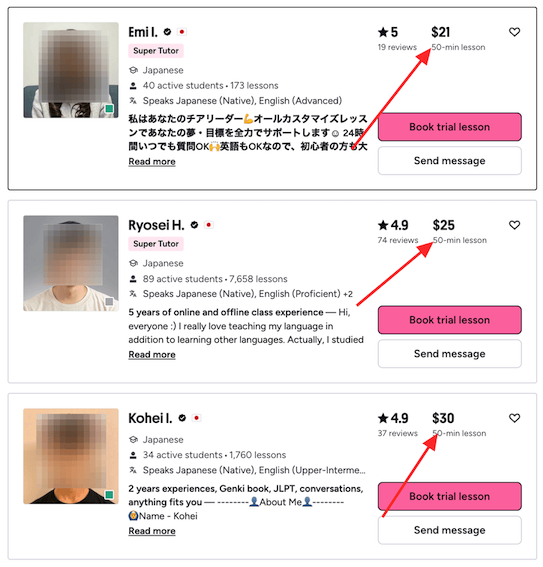
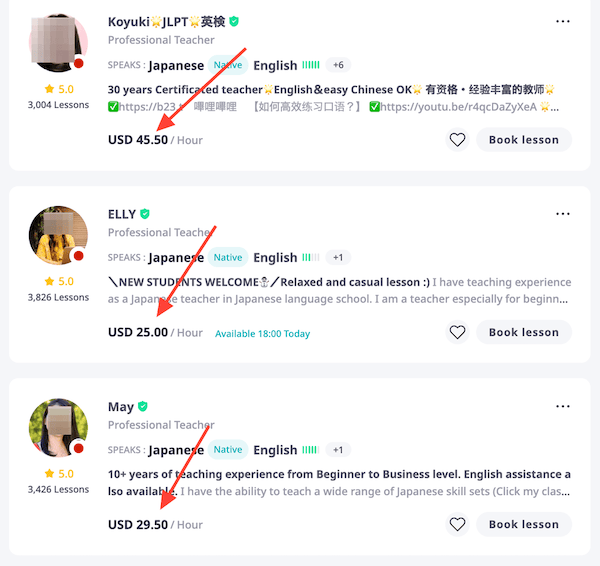
- Cost: this is for those who speak with tutors or in a school setting. Private tutors can vary widely in cost but it's quite common for them to be upwards of $20 to $40 per hour. Since to improve we need as much practice as possible that quickly becomes quite expensive
The Solutions
Let's go over some of the ways you can get more conversation practice. At the end we'll summarize the pro's and con's of each and give you our overall recommendations.
Talk to Yourself
This is a great zero-friction way to start your speaking practice. There is no shyness here and you can do it anytime anywhere, especially if you don't mind looking crazy. Even as a beginner you can start talking to yourself. If you find you don't know how to say something, just make a note of what you wanted to say and look it up later. This method allows you to exercise your speech muscles and forces you to recall vocabulary, grammar, and sentence construction. The obvious problem is the lack of corrective feedback and perhaps the dullness of the conversation. Nevertheless it's a great place to start.
Shadowing
Shadowing is a super exercise that many polyglots swear by. The principle is simple: listen to speech in your target language and just repeat what you hear. The idea is that you'll gradually parse out more and more of what you hear into individual words and particles. This will improve your listening which is crucial for conversation. It'll also accustom your mouth and tongue to pronounce the sounds and words in your target language.
Shadowing should involve no anxiety or shyness. It's also something you can do just about anytime. Remember when shadowing to speak out loud rather than repeating in your head. You can speak softly or whisper but get those speech muscles moving.
Read Aloud
Reading aloud is another excellent way to get your mouth moving and improve your speaking skills. The key word here is aloud. Reading silently as we typically do may not be as effective in improving speaking skills. Similarly, you should strive to read in Japanese itself rather than romaji. The problem with romaji is that often our pronunciation is romanized too. If you can maintain Japanese pronunciation while reading romaji then that should work well too. You can find some free reading material on sites like 小説を読もう ("let's read short stories").
Make Friends
Easier said than done, but there's genuinely no more engaging, fun, and effective way to improve your speaking skills than to make and chat with friends in your target language. Here you'll have to overcome the anxiety barrier which is easier said than done. For people who are naturally outgoing and extroverted and who are not self-conscious or censoring, this is the fastest, most effective way to improve your conversation skills. The more friends the better as you can always find someone who's free for a chat or a hang out when you're down to talk
Find a Language Exchange Partner
There are several websites you can use to find language exchange partners. These can be fun and productive ways to improve your conversation skills. It can also be cost effective as language exchange means you each give up your time to help out the other and this means it's free for you both.

Nonetheless there are certain problems with language exchange. We've mentioned these above but to recap: scheduling issues, speaking in your non-target language for your partner's sake does not help you improve, limited feedback, and level mismatch.
Hire a Tutor
To overcome some of the issues with conversation partners you may choose to hire a tutor.
Tutors are awesome. Firstly, they're paid to spend time with you so in principle you shouldn't feel anxious, shy, or guilty. No matter how foolish or slow or wrong you might think you sound, it doesn't matter since they're being paid to help you out. Second, a professional tutor should be able to provide constructive feedback and explain your mistakes in an easy to understand manner.
This is all in theory - in practice of course we can't help but sometimes feel a little anxious or embarassed even with our paid tutors. Moreover, professional Japanese teachers who are certified and able to speak multiple languages and explain concepts clearly are typically rare and quite expensive. Lastly, given that you are typically not your tutori's only student and given any potential timezone differences, Japanese tutors may not always be available on your schedule.
The next option addresses several of these shortcomings and is increasingly what language learners are turning to.
AI Conversation Partners
AI Conversation Partners are a relatively new innovation in the world of language learning. Like just about every industry, education generally, and language learning in particular, are seeing dramatic improvements due to AI.
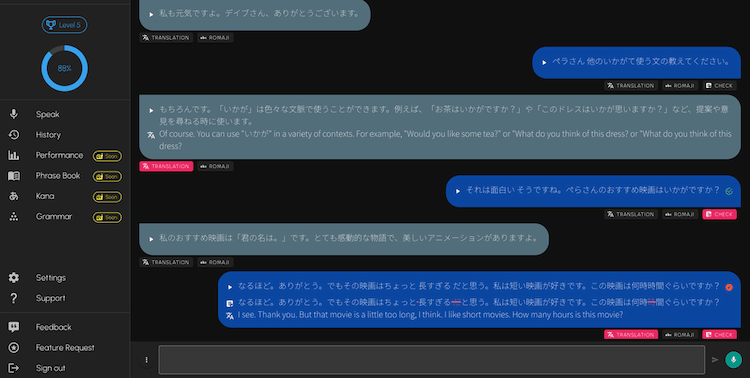
The idea is simple: speak in Japanese to an always-available AI personality that can provide feedback and corrections as you go. The best AI conversation partners can speak with a human-like voice, provide transcripts for the entire conversation, understand your spoken Japanese no matter how broken, provide translations, romaji, and corrections. They can suggest responses for you when you get stuck.
Pera is the only AI conversation partner built specifically for Japanese and only Japanese. That means you can text Pera in Japanese regardless of your keyboard setup and it provides romaji and idiomatric translations. It understands your spoken Japanese and can tailor the level of "formality" for the situation.

Pera was designed to allow Japanese learners to speak Japanese from day 1 using a graded and guided conversation format.
Recent advances in AI have meant that AI can now hold engaging, natural conversations and use lifelike, realistic voices and intonations. These technologies are getting better every day meaning that this method for conversation practice is only going to get more effective with time.
The advantages of an AI conversation partner are obvious:
- Speak anywhere anytime, not bound by a conversation partner or tutor's schedule
- A fraction of the cost of a tutor and incomparably cheaper than a language school
- Conversation matches your level, therefore suitable from absolute beginner to advanced
- Access to dictionaries, slowed down pronunciation, translations, transcriptions, and romaji for your entire conversation
- Tracking of improvement over time
- Can tailor speech speed and complexity to suit your level
- Multimodal learning: combine reading and writing, listening and speaking, grammar and vocabulary, kanji and kana, all in one place. Practicing each one will automatically reinforce the other
- Possibly most important of all: No anxiety, no shyness! Meaning you build the muscle memory, brain-mouth connection, and confidence necessary to talk fluidly with actual people
Using AI conversation partners is likely to become the go to method for acquiring any language and until it's widely adopted is a secret weapon for those committed to becoming fluent as quickly as possible.
Mix and Match
Obviously you don't need to stick to just one of these methods. You can mix and match them as you see fit.
If you have friends to talk to, awesome. You might still want to use an AI on your downtime, while doing the dishes for example, or walking to the supermarket. You might still want to shadow the news to improve your keigo, or talk to yourself while in the shower. The point is talk as much as possible and to do so consistently. Give yourself 3 months of daily talking. The improvements will be so impressive that you'll keep going for another 3 months, and then another and another.
If you have a tutor once a week, you can spend the rest of the week talking to your AI conversation partner (and watch how shocked your tutor will be at your rate of improvement). Likewsie, you can do shadowing some days and other days talk to yourself. The key is to keep your mouth moving no matter what.
Summary
The most important thing is to start speaking and to do so often. The second most important thing is to get feedback and ensure you're improving every day. The 7 approaches listed here are all useful in their own way. We may be biased but we think that using an AI conversation partner in conjunction with any of these methods is a secret weapon that's sure to accelerate your path to fluency. Pera is the only dedicated Japanese AI conversation partner. The entire platform is built with Japanese and only Japanese in mind. Use it for free and use it to juice up any study regiment. You'll be amazed how far you'll go in only 3 months.
| Advantages / Methods | Talk to Yourself | Shadowing | Read Aloud | Make Friends | Language Exchange Partner | Hire a Tutor | Talk to AI/Pera (heypera.com) |
|---|---|---|---|---|---|---|---|
| Flexibility to Practice | ✅ | ✅ | ✅ | ❌ | ✅ | ❌ | ✅ |
| No Social Anxiety | ✅ | ✅ | ✅ | ❌ | ❌ | ❌ | ✅ |
| Personalized Feedback | ❌ | ❌ | ❌ | ❌ | ❌ | ✅ | ✅ |
| Cultural Exchange | ❌ | ❌ | ❌ | ✅ | ✅ | ❌ | ✅ |
| Available 24/7 | ❌ | ✅ | ✅ | ❌ | ❌ | ❌ | ✅ |
| Cost-effective | ✅ | ✅ | ✅ | ✅ | ❌ | ✅ | ✅ |